
The ultimate lash growth serum ingredient?
Bimatoprost sits at the intersection of pharmaceuticals, cosmetics and beauty. Understanding it requires separating the molecule from any brand name, a clinical finding from a marketing claim, and an observed side effect when used for glaucoma from its use for cosmetic enhancement.
The molecule with the best demonstrated eyelash and eyebrow growth.
Controlled lash and brow trials, including FDA approval.
Rare. Irritation, pigmentation and periorbital changes can occur, especially with careless application.
Before reading: this is information written by a doctor with almost two decades of experience with bimatoprost. The author founded Mylash and Opti Laboratories, both discussed below. Read the ownership and evidence disclosures.
What is bimatoprost?
Bimatoprost is a synthetic prostaglandin analogue used to lower pressure inside the eye and to increase eyelash growth. It is an active ingredient and not a brand name. Latisse, Lumigan, Mylash and a cosmetic serum containing bimatoprost are different products even though they have the same ingredient.[1][2][3]
What type of substance is bimatoprost?
Bimatoprost is not a peptide, a vitamin or a herb. Chemically it is related to naturally occurring lipid signals known as prostaglandins. Its structure contains a five membered ring, several hydroxyl groups and an amide containing side chain. The arrangement of these groups in three dimensions is part of its identity rather than an incidental detail.[4]
Descriptions such as "prostaglandin analogue" and "prostamide analogue" appear in discussions of bimatoprost. The former covers the broader consumer category while the latter refers to its particular chemical and pharmacological characteristics. These terms are not interchangeable with bimatoprost as you can have a "prostaglandin analogue" that is a completely different molecule.[4][2]
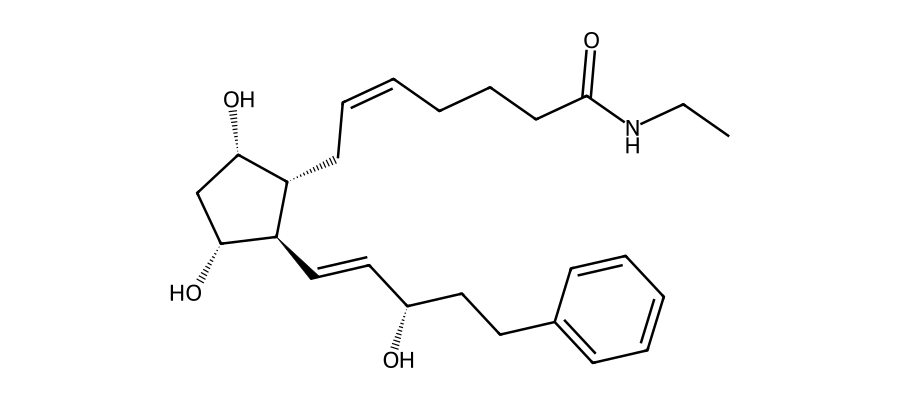
- Generic ingredient name
- Bimatoprost
- Molecular formula
- C25H37NO4
- Molecular mass
- Approximately 415.6 g/mol
- CAS number
- 155206-00-1
- PubChem identifier
- CID 5311027
- Development code
- AGN 192024
What was bimatoprost originally used for?
The original medical application of bimatoprost was as an eyedrop for glaucoma. It reduces intraocular pressure by increasing the drainage of aqueous humour, the fluid found inside the front of the eye.[1][5]
Eyelash growth was first noticed as a separate effect. A person using this glaucoma treatment will often develop longer and thicker eyelashes as a side effect. Development of an eyelash treatment turned that observation into an intended outcome by switching the application to the lash line and starting dedicated clinical testing. This is an example of a drug being developed for an additional use - other commonly known examples being Viagra, Botox and Minoxidil.[6][3]
What do 0.03%, 0.01% and 0.3 mg/mL mean?
These numbers tell you the strength of the dose. The treatment is a water based solution and 0.03% corresponds to 0.3 mg of bimatoprost per millilitre, while 0.01% corresponds to 0.1 mg/mL. It is not the total quantity in a bottle.[7]
The most commonly used strength for eyelash and eyebrow growth is 0.03%. The 0.01% is primarily used for glaucoma treatment although it may be used for eyelash and eyebrow enhancement in certain circumstances.[8][9]
Is bimatoprost a hormone, steroid or peptide?
Bimatoprost is not a steroid such as testosterone or oestrogen. It is not a peptide either and is not classed as a hormone. It interacts with a lipid signalling system in the eicosanoid family. People sometimes use "hormone" informally for anything that changes cell behaviour but that usage obscures rather than clarifies. The useful questions are how does it work and what evidence exists for its use.[4]
Is bimatoprost the same as Latisse, Lumigan or Mylash?
Bimatoprost is the ingredient. Latisse, Lumigan and Mylash are product names. Latisse is associated with the US eyelash indication. Lumigan is associated with lowering eye pressure. Mylash is associated with the UK eyelash service. Although they contain the same active ingredient, they have different packaging, instructions and applicators.[1][3]
The same distinction applies to a cosmetic formulation. Identifying bimatoprost in a serum tells a reader something important about its active ingredient. The brand comparison separates the questions you should then consider.
How does bimatoprost work?
Bimatoprost stimulates growth of the hair follicle rather than simply coating the visible hair. The evidence is consistent with promotion of the active growth phase and these changes make the hairs more prominent. Some mechanistic details remain unresolved and laboratory findings should not be presented as a complete explanation of every human response.[10][11]
What are prostaglandins?
Prostaglandins are lipid derived signalling substances made naturally within the body. They participate in local communication between nearby cells. The relevant comparison is not with a building material such as keratin but with a signal that changes what a cell does. Different prostaglandins can have different, sometimes opposing, effects. "Prostaglandin" is therefore a family description rather than the name of one universal growth switch. The body has many overlapping signals to regulate hair growth.[6][12]
What is a prostaglandin analogue?
In medicine and biology more broadly, an analogue means something that is designed or identified to have close structural similarities to another molecule. Any changes to the structure can affect how a molecule interacts with a receptor, how it penetrates tissue, how stable it is, and how it is metabolised. This means that molecules that are prostaglandin analogues, such as bimatoprost, latanoprost and isopropyl cloprostenate, should not be treated as equals that can be simply swapped.[4][6][13]
This distinction is especially important in lash serum comparisons. A study of bimatoprost does not become a study of isopropyl cloprostenate because both are described as prostaglandin analogues. Nor does a finding about one ingredient establish the properties, such as incidence of an adverse reaction, with another.
What is a prostamide analogue?
Bimatoprost is recognised as a prostaglandin analogue and is also commonly classified, more specifically, as a prostamide analogue. The "amide" in prostamide describes a chemical feature, specifically meaning it has an -CONH2 group. Prostamides and prostaglandins are both natural and related compounds. Their synthesis often shares processes, starting molecules, and enzymes. Both act as signalling molecules in processes and areas across the body.[4][10]
What is the eyelash and eyebrow growth cycle?
A hair will grow, stop growing, rest and then eventually shed as its follicle renews itself. The visible hair and the follicle are different structures: the hair shaft is the fibre we see, while the follicle is the living structure in the skin that produces hair. Most of the time a follicle is resting rather than growing. Understanding this distinction helps explain both natural shedding and the delayed response to a growth treatment.[14][15]
One follicle. A repeating cycle.
Grow. Transition. Rest. Renew.
Anagen: the active growth phase
During anagen cells in the hair bulb produce the material that becomes the shaft. New hair length is added at the base rather than the tip. Pigment is incorporated while the hair is being formed. The duration of this active phase helps determine how long a lash can become. It is much shorter for eyelashes and eyebrows than for scalp hair which is why a normal lash or brow does not grow the same length as scalp hair.[14][16]
Catagen: the transition phase
During catagen, the active production of the hair slows and the lower part of the follicle regresses. The follicle changes from actively growing the hair into a resting state. This transition is a normal part of renewal.[16]
Telogen: the resting phase
During telogen the growth has fully stopped. The majority of hairs are in this resting phase at any time.[15][16]
Exogen: release of the old hair
Exogen describes shedding of the retained hair. It is useful to show it as a fourth step although in reality the release of the old shaft and the next growth phase can overlap. The animation simplifies these events rather than depicting four equal periods. Normal shedding removes a hair, not the follicle.[16]
How long does the eyelash or eyebrow growth cycle last?
There is no single timetable for every hair. In a 2010 study, researchers estimated an average anagen duration of 34 ± 9 days, a complete cycle of 90 ± 5 days, and growth of 0.12 ± 0.05 mm per day. Only four volunteers underwent the nine month follow up, so while these are useful observations, the sample is too small to draw conclusions with a high level of confidence. Other methods and populations produce different estimates, and other studies have produced slightly different ranges.[14]
Neighbouring follicles are not synchronised. Some are growing while others are resting or shedding. In a small histological investigation, active follicles also differed between upper and lower eyelids. The visible lash line therefore changes gradually rather than replacing itself all at once.[15]
Where does bimatoprost act in the cycle?
Bimatoprost promotes the transition into anagen and increases the time spent actively growing, although its complete eyelash mechanism has not been established. Experimental work has demonstrated a direct response when applied to human hair follicles.[3][10]
This is why consistent use is assessed over months, not days. It needs time to stimulate enough hairs to alter the whole lash line. It does not instantly lengthen every resting hair as it takes time for the hair to move from resting to growing. When the treatment stops, subsequent cycles gradually return towards the untreated pattern.[17]
For a longer comparison of lash, brow and scalp hair growth cycle, see Dr Tom Walker's explanation of the eyelash growth cycle. [16]
Does bimatoprost make new follicles?
The clinical findings show improved lash prominence, length, fullness and darkness. They do not establish that bimatoprost creates a new set of follicles. More visible hair can reflect changes in the activity and appearance of existing follicles. It is important not to turn "fuller lashes" into an unsupported claim that a person has grown twice as many follicles.[3][17]
That distinction also matters for damaged eyebrows. A result in thinning but viable follicles should not be extrapolated to an area where follicles have been destroyed by scarring. If the follicle has been permanently damaged then a growth serum will not have anything to stimulate.
Does it work on eyebrows in the same way?
Yes. Many participants in controlled studies have successfully achieved fuller, thicker eyebrows with bimatoprost. This is clinically proven and not simply an assumption based on the results from eyelash growth. In a seven month trial involving 357 adults it was shown that bimatoprost 0.03% improved eyebrow fullness compared with a placebo. The detailed outcomes are set out in the eyebrow results.[18]
Smaller trials have also measured increases in eyebrow hair density and diameter, as well as improved satisfaction. The practical aim is to make the hairs produced by surviving follicles more visible and substantial. Bimatoprost has not been shown to replace a follicle destroyed by scarring and a medical cause of brow loss still needs appropriate assessment.[19][20]
Bimatoprost and vellus hair transformation: can fine hairs become more visible?
Fine, lightly coloured hairs can contribute more to eyebrow fullness if they grow thicker, longer or darker. These changes are sometimes described as “vellus hair transformation” or “terminalisation”. Vellus hairs are the fine, often barely visible hairs that are colloquially known as "peach fuzz". Terminal hairs are the coarser, more conspicuous hairs that largely define the eyebrow. Not every fine brow hair is a true vellus hair - some are naturally fine terminal hairs or recently regrowing hairs.[21]
By stimulating the vellus hairs a brow can appear denser without gaining new follicles. A previously inconspicuous hair will become easier to see. Investigators explicitly discussed this possibility when planning an eyebrow bimatoprost trial. It is a plausible explanation for part of the visual improvement but a trial rationale is not proof that every treated vellus follicle changes its biological type. Anecdotal evidence gathered over the years supports vellus hair transformation with bimatoprost but more research is needed to confirm it independently.[21]
There is direct evidence for increased eyebrow hair diameter and density. A six month, randomised study in 40 people found that bimatoprost 0.01% improved both measures compared with vehicle. That supports the possibility of finer hairs becoming more substantial even though it does not prove permanent vellus to terminal conversion as the main process.[19]
For someone with fine hairs still visible in a sparse brow this is a potentially encouraging mechanism of growth. The extent of improvement varies but is often enough for a decent cosmetic outcome. The studies do not establish an irreversible transformation, a response in every fine hair or regrowth if the follicle has been lost.
How is stimulating growth different from conditioning?
A conditioner works principally on the surface of the hair. A growth serum is intended to alter the process producing the hair. Both approaches can influence how full a lash line looks but they are not the same intervention. A fuller appearance could arise from less breakage, a coating, altered pigmentation, longer hairs or a combination of changes.
This is why a comparison needs to say what was measured. A consumer saying that lashes "look healthier" is reporting a useful experience but it is not the same as a measurement of eyelash length. Neither should be relabelled to make a product sound more impressive. The evidence section explains how to read these results.
What are the possible side effects of bimatoprost?
Most participants in eyelash trials tolerated bimatoprost well and the great majority did not experience any one of the individual common reactions. In the pivotal four month study, each of the six most frequent treatment related reactions affected fewer than 4% of the bimatoprost group.[22][3]
How often do people have no side effects?
A pooled eyelash analysis recorded a treatment related adverse event in 21.0% of 680 bimatoprost treated participants over studies lasting up to 12 months. Conversely, 79.0% had no recorded adverse event. Most reactions were mild and local. Adverse events led to treatment discontinuation in 3.2% of bimatoprost participants versus 2.4% with placebo. These figures show good tolerability but remind us that there is always a small chance of having a side effect.[23]
An adverse event is any recorded health problem during a study. A treatment related event is one judged related to the treatment studied. Rates also depend on follow up and the questions asked. The percentages below describe specific four month findings, not lifetime risks or a prediction for every cosmetic formulation.
How extensive is the experience with bimatoprost?
Bimatoprost has decades of medical use and millions of patient years of documented exposure. A 2011 safety paper cited a manufacturer estimate of approximately 11.25 million patient years of worldwide exposure to bimatoprost 0.03% eye drops, an area far more sensitive than the skin. It also analysed glaucoma studies with follow-up extending to 48 months.[24]
A patient year means one person treated for one year so one person treated for five years contributes five patient years. This is substantial experience applying the treatment continuously for years on the delicate tissue of the eye. However, eye drop exposure differs from eyelid skin application so its side effect rates are not interchangeable.[24]
What side effects are most often reported with cosmetic eyelash and eyebrow treatment?
The following table shows both sides of the pivotal FDA trial results: how many participants reported each reaction and how many did not. The active treatment group contained 137 adults and follow up lasted four months.[22]
| Treatment-related reaction | Reported with bimatoprost | Not reported with bimatoprost | Reported with placebo |
|---|---|---|---|
| Eye itching | 5/137 (3.6%) | 132/137 (96.4%) | 0.7% |
| Eye redness | 5/137 (3.6%) | 132/137 (96.4%) | 0.0% |
| Skin darkening | 4/137 (2.9%) | 133/137 (97.1%) | 0.7% |
| Eye irritation | 3/137 (2.2%) | 134/137 (97.8%) | 1.4% |
| Dry-eye symptoms | 3/137 (2.2%) | 134/137 (97.8%) | 0.7% |
| Redness around the eyelids | 3/137 (2.2%) | 134/137 (97.8%) | 0.7% |
The "not reported" column is calculated from the published counts. The placebo group contained 141 adults. The same person could report more than one reaction so these rows cannot be easily combined to calculate the proportion with no side effects at all.[22][23]
Itching and redness
The overwhelming majority did not report either of these reactions in the FDA study. Itching and redness can nevertheless occur. Some say that itchiness indicates growth is occurring but this is not correct. Redness of the eye and redness of the eyelid skin are distinct observations.[22][3]
Irritation and dry eye symptoms
More than 97% did not report each of these reactions in that four month study. Existing dry eye, other ingredients and accidental eye exposure are all relevant to an individual's symptoms. Persistent irritation should be questioned rather than tolerated. It is often a suggestion that too much liquid is being applied.[22][3]
Unwanted hair growth outside the application area
This was not one of the six most frequent reactions in the pivotal trial. Repeated contact with surrounding skin can produce unwanted hair growth. Keeping the application within the instructed area and removing excess helps limit spread. While classed as a side effect, it also demonstrates how effective the treatment is.[3]
Temporary shedding or breakage
Most participants did not report lash loss in the trials. It was recorded in 6 of 680 people (0.9%). Temporary shedding and breakage is a difficult one to evaluate. Shedding is a normal part of the hair cycle and breaking is often mechanical in cause.[23][3]
Can bimatoprost change eye colour permanently?
Most eyelash trial participants did not develop any iris colour change. The pooled analysis described two reports that were both mild and potentially influenced by assessment variability. Nevertheless, increased brown iris pigmentation is a recognised effect of bimatoprost when used as eye drops so it is a theoretical risk.[23] This concerns the iris which is the coloured part of the eye.[25]
A useful risk discussion should be neither "this always happens" nor "this cannot happen if it is applied correctly". Cosmetic application for eyelash and eyebrow growth differs a great deal from instilling a full drop into the eye. It has been found that the amount of liquid used is approximately one-twentieth as much for cosmetic eyelash growth when compared to its use for glaucoma. The absence of iris changes in a particular trial or a practitioner's experience does not make it impossible.[3][23]
Can it cause dark circles or eyelid darkening?
Skin darkening was not reported by 97.1% of the treatment group in the FDA four month trial. Where eyelid pigmentation develops the American product information sheet describes improvement after stopping in most affected patients. This is reassuring but does not guarantee the same outcome for every cause of darkness.[22][3]
"Dark circles" is an imprecise description. Darker skin, redness, visible vessels and localised swelling can all be perceived as darkness. It is therefore unhelpful to assume that every change under the eye is pigmentation.[25][26]
This distinction matters when judging recovery. Lighting, swelling, camera angle and skin colour can change the image.
What is prostaglandin associated periorbitopathy?
Periorbital change was not a typical finding in the eyelash trials. One case of enophthalmos was reported among 680 bimatoprost treated participants in the pooled analysis. That low observed count is reassuring context but the trials cannot establish the true frequency of every change during longer cosmetic use.[23]
Prostaglandin associated periorbitopathy, often shortened to PAP, describes a group of changes around the eye associated with use of prostaglandin analogues, particularly for glaucoma. These can include deepening of the upper eyelid sulcus, altered lid position and a reduction in volume around the eye. It is thought to be the result of reduced fat around the eyeball.[26][27]
Evidence from long term use of bimatoprost for glaucoma is relevant because it identifies a possible biological effect. It cannot simply be converted into a precise percentage for cosmetic use. We do know that amount applied cosmetically is twenty times less than is used for glaucoma but this does not translate to a precise estimate either. Dose, duration, baseline anatomy, product and application all need to be considered. There is not a reliable personal calculator that predicts whether a given lash serum user will develop hollowing.
Is periorbital fat loss reversible?
Most using the treatment for eyelash or eyebrow growth in a trial did not report periorbital changes in the first place. For those who develop it, some improvement after discontinuation has been documented.[23] In a small case series, patients with prostaglandin associated changes showed improvement after treatment was withdrawn. This is reassuring in one respect but it is not proof that every patient recovers completely or within the same interval of time.[27]
There are several uncertainties such as whether the change was caused solely by the treatment, how much tissue was affected, what happens with longer follow up and whether photographs capture the relevant changes consistently. "It can improve" is supported more carefully than "it always reverses". One consideration is a matter of scale - these treatments have now been used by millions of users around the world for cosmetic eyelash and eyebrow growth, yet this side effect has not been greatly reported in the literature or in the press.
Can bimatoprost affect vision or eye pressure?
Clinically important pressure problems were not typical of the eyelash trials. No participant in the pooled analysis had persistently low eye pressure. Nevertheless bimatoprost is capable of lowering pressure within the eye and that is its original medical purpose.[23] People already using glaucoma medicines should tell their doctor about any eyelash treatments. An additional prostaglandin related product should not be assumed to be irrelevant because it is sold for a cosmetic purpose. Often it is better to avoid a prostaglandin analogue for a cosmetic purpose if you are already using one for glaucoma treatment.[1][5]
Visual disturbance, eye pain or marked persistent redness should not be dismissed as a sign that a serum is "working". The product information also contains precautions for particular ocular conditions including inflammatory eye disease and macular oedema.[3][28]
When to get urgent help
Seek urgent medical or eye care advice for new significant eye pain, a change in vision, or a severe eye reaction. Stop the cosmetic serum while obtaining advice. Call 999 for severe breathing difficulty or swelling of the mouth or throat. A prescribed glaucoma treatment should not be abandoned without medical advice because uncontrolled eye pressure also carries risk.[25][7]
What does a postmarketing report tell us?
A postmarketing report describes an event noticed after a product has entered wider use. Such reports can identify problems that small or shorter trials would miss. They do not ordinarily provide a clean denominator which means that we do not know how many people used the product, how much they used or whether other explanations were present.
That means a report can be important without proving a frequency or a cause. The reverse is also true - uncertainty about the frequency of an effect does not justify removing it from an honest discussion. The appropriate response is to explain both the signal and its limitations.[3][23]
Is bimatoprost safe?
Bimatoprost eyelash treatment has a favourable safety profile and most participants in clinical trials had no recorded treatment related side effects. Long term studies and substantial medical exposure add reassuring context. They support informed use rather than a promise of zero risk.[17][23]
What does "clinically tested" actually mean?
It can mean a few things. It could refer to a controlled trial, a small open label assessment, a dermatologist's inspection or a questionnaire about satisfaction. A useful claim should state who was studied, how many participants there were, which product was used, the comparison group and the outcomes measured.
Evidence about the active ingredient and evidence about the finished product are related but distinct. A formulation may change delivery to the skin, stability or tolerability. A claim that a cosmetic contains a well studied ingredient should not silently become a claim that the cosmetic itself was tested in all of those studies. Glaucoma formulation trials illustrate why that distinction matters since the side effect frequency seen when the same treatment is used cosmetically is far lower.[9][8]
What do longer term eyelash studies show?
A randomised study of 368 participants followed cosmetic bimatoprost treatment for up to 12 months. It included people with idiopathic eyelash hypotrichosis and people recovering after chemotherapy. The investigators reported a sustained benefit and no serious side effects. That is useful evidence but it does not promise that everyone will have no side effects.[17]
A pooled analysis combined safety data from six trials including 680 bimatoprost treated participants and 379 placebo participants. Local ocular and skin reactions showed a low level of side effects.[23]
What has been reported by longer term cosmetic bimatoprost users?
A 2014 observational study included 585 people who had used bimatoprost for at least 12 months, with an average treatment duration of 19.3 months. It reported 92.5% satisfaction, no serious or severe side effects and no eye colour changes. At interview, 27.4% recalled some sort of issue during treatment although only four events were found by those running the trial.[29]
These findings support high satisfaction among long term users and this matches the anecdotal experience of many clinicians.
Can experience over many years replace clinical trials?
Long clinical experience can identify practical questions and unusual patterns. It is not the same as prospective measurement in a trial. A practitioner may not see every adverse reaction, a customer may stop without reporting why, and a comparison group is often absent. These limitations apply to a reassuring anecdote just as much as to an alarming one.
The most credible account uses both kinds of information appropriately. Clinical trials are the gold standard that provide a defined population and appropriate measurements. Postmarketing observations extend the range of real world experience. Personal experience should be labelled as such rather than presented as a statistical guarantee.
Who should obtain individual advice before using a growth treatment?
People with existing eye disease, significant dry eye, previous eye inflammation, recent or planned eye surgery, or a history of a reaction to the product should discuss suitability with their doctor. The same applies to anyone using medicines that affect eye pressure. NHS guidance for medical bimatoprost identifies a range of conditions and medicines that should be disclosed.[28][30]
Sudden, patchy, painful or inflamed lash or brow loss deserves assessment of the cause. The question is not only whether a serum can make some hairs look fuller. It is also whether an underlying condition needs treatment, whether the skin is suitable for application and whether delaying diagnosis could be harmful.
What about pregnancy and breastfeeding?
For cosmetic lash or brow enhancement it is best to take a cautious approach. Treatment is best avoided during pregnancy and breastfeeding as there is a lack of reassuring data to prove that harm will not occur.[3][13]
There is an important exception to this: a person prescribed bimatoprost for glaucoma may still need it during pregnancy. This scenario would be handled by your doctor during pregnancy.[31]
Are prostaglandin free serums automatically safe?
No. Removing a particular ingredient class removes exposure to that class but a different product can still cause irritation or allergy. Safety needs to be tied to the actual formula and circumstances of use and not inferred from the shelf on which the product sits.
A prostaglandin free product does not provide the effectiveness of bimatoprost when it comes to growth. It may use conditioning ingredients or peptides and measure a different outcome. The brand profiles identify those differences without treating one category name as a verdict on every product.
What did the 2026 European safety assessment conclude?
In an opinion adopted on 2 February 2026, the European Commission's Scientific Committee on Consumer Safety considered three cosmetic prostaglandin analogues: isopropyl cloprostenate, methylamido-dihydro-noralfaprostal and dechloro dihydroxy difluoro ethylcloprostenolamide (also called ethyl tafluprostamide). It concluded that these ingredients could not be considered safe for cosmetic eyelash and eyebrow growth. They cited potent pharmacological activity and insufficient data to exclude relevant reproductive and developmental concerns.[13]
This was a scientific assessment of those specified substances. It should not be described as an automatic blanket ban on every UK lash serum. Interestingly, they did not review whether bimatoprost could be considered safe or unsafe despite it being the most studied eyelash growth ingredient. Regulatory status and scientific conclusions are related questions but not interchangeable ones and the exact ingredient name is important.
Does a patent or a cosmetic safety assessment prove effectiveness?
No. A patent concerns claimed inventions and legal rights. A safety assessment addresses safety within its scope. Neither automatically demonstrates a consumer benefit. An ingredient's inclusion in a database does not mean that a regulator has endorsed every product containing it. Keeping these questions separate prevents a scientific looking collection of documents from being mistaken for a clinical trial or approval.
How is bimatoprost used for eyelashes and eyebrows?
Precise application gives the best results. The treatment needs to be applied to the skin at the base of the hair that you wish to stimulate. This is usually along the eyelash line but also the eyebrow hairs can be stimulated too.[11][18]
What is the Latisse application method?
The Latisse regimen uses a small amount of liquid applied once each evening on upper eyelid margins. Makeup and contact lenses are removed first. A drop is placed on the supplied sterile disposable applicator and applied along the upper lash line and excess liquid is blotted away. A fresh applicator is used for the other eye. It is not applied to the lower lash line.[11][3]
Why do hygiene and the applicator matter?
A liquid used close to the eye should not be treated like a standard makeup. It is important to avoid touching the bottle tip to the skin or other surfaces. Cleaning the brush supplied is important as it prevents build up of bacteria that could be spread to the eye area. [11][7]
Can bimatoprost be applied to the lower lashes?
The Latisse eyelash instructions specify the upper lid margin rather than deliberate lower lash application. The theory is that an adequate amount of the liquid will be transferred from the top to the bottom lash line when you blink. Some people find that they achieve a better result when applied to the bottom lash line directly. However it must be noted that no clinical study has looked at this to determine whether the results are better or if it increases the risk of any problems.[11]
Can it be used on eyebrows?
Yes. Many people have achieved fuller brows with bimatoprost in randomised clinical trials. The findings support eyebrow enhancement with cosmetic bimatoprost as a safe and effective treatment. It is important to consider if thinning eyebrows indicate an underlying problem. An unexplained patch of missing eyebrow hair should not automatically be treated as a cosmetic deficiency. For a longer review of eyebrow loss, see Dr Tom Walker's article on causes of eyebrow loss.[18][20]
Can more product or twice daily use make lashes grow faster?
More frequent eyelash application does not produce a better result. More liquid simply increases the opportunity for spread beyond the intended area and irritation. Increasing exposure in response to impatience is a different experiment from following the tested regimen.[11]
Eyebrow research has included once and twice daily groups. That should not be interpreted as a recommendation to double eyelash applications or as proof that twice daily is superior for all outcomes. A study population, product and anatomical site belong together when interpreting a regimen. The best recommendation is to apply it once a day.[18]
What should I do if I missed an application?
For a missed application you should resume the regular schedule rather than applying extra to compensate. Hair growth is not usefully accelerated by trying to "catch up". A routine that is easy to follow is preferable to repeatedly changing when and how you apply.[11]
Medical eyedrop instructions can differ in how they describe missed doses. If you are using bimatoprost for glaucoma treatment then you should consult the instructions that come with the medication. The consequences of poor glaucoma control are not cosmetic.[7]
What about contact lenses, mascara and other products?
Contact lenses should be removed before using Latisse or bimatoprost. If you wish to reinsert then a 15 minute interval is required before doing so. The reason for this is that any liquid can persist on a contact lens and this can cause problems to the eye.[11][7]
Makeup should be completely removed before application. If the eyelid is irritated or recovering from a procedure, then it is best to avoid application until the area has healed. Obtain advice about the cause and timing of further use.
Can I use it with lash extensions or after eye surgery?
Bimatoprost is water based and usually does not interfere with the commonly used adhesives for eyelash extensions. People have used bimatoprost to help transition away from extensions, especially if they have found that the extensions have been damaging their eyelashes.
After eye surgery the operating clinician should advise when the surface and surrounding skin have healed sufficiently for a cosmetic product. "Two weeks for everyone" is not a reliable rule and it is best to err on the side of caution. The type of operation, postoperative medicines and healing progress can differ. If the area feels tender or raw then no cosmetic should be applied.[28]
How should a product be stored and when should it be discarded?
Bimatoprost does not need to be kept in the fridge. It should not be kept anywhere too warm and the lid should be kept on it when you are not using it. When used cosmetically, many find that one 3ml bottle will last three months of daily use. This is different from glaucoma - if used as an eye drop then you should only use a 3ml bottle for 28 days.[7]
Keep the original packaging and ingredient information. If a reaction occurs then the actual product, batch and application history are more helpful than a recollection that it was "a lash serum". Do not dilute, mix or decant bimatoprost into another serum or tube at home: that introduces uncertainties about concentration, stability, handling and delivery.
Bimatoprost and localised fat reduction
Bimatoprost associated fat loss has been demonstrated in a few clinical trials but it is not a commonly used cosmetic treatment. There has been an interest in using bimatoprost for localised fat reduction. Clinical evidence does not establish a reliable home method for reducing eye bags, jowls, cheek fat or other small fat deposits.[26][32][33]
Why has bimatoprost been discussed for fat loss?
Some glaucoma patients using prostaglandin related eye drops notice a reduction in fat around the eye. Such observations raise the question of whether these compounds alter the amount or behaviour of fat cells? That question is separate from whether the change is aesthetically desirable.[26][27]
A loss of volume that troubles one person can sound appealing to another who dislikes a prominent fat pad. That change in preference does not change the quality of the evidence we have. A treatment capable of altering fat still needs carefully controlled testing before it can be described as a suitable treatment for precise facial contouring.
What did the orbital MRI study find?
A small 2019 study used magnetic resonance imaging in nine people treated with bimatoprost in one eye for glaucoma. The treated side had lower measured orbital fat volume than the untreated side. Using the opposite orbit as a comparison made the finding informative but the study was small and observational.[26]
It did not establish the frequency of fat loss among all users or the dose needed to produce a particular aesthetic result. It also examined orbital fat, not a generic layer of “facial fat”. Those are limitations of what was studied and not reasons to disregard the observation.
Does bimatoprost destroy fat cells?
Laboratory studies have investigated effects on adipogenesis which is the process by which precursor cells become fat storing adipocytes, and on fat accumulation. Early findings support a biologically plausible process for altered fat tissue.[32][12]
That is not equivalent to saying that eyelash or eyebrow application will dissolve fat cells. Reduced lipid storage, altered cell differentiation and destruction of existing cells are different processes and this is not being seen in clients routinely using the treatment to grow their eyelashes and eyebrows.
The practical conclusion is that bimatoprost should not be used to self-treat a fat deposit at this stage. A change that appears in a casual photograph could be a different problem from the one being targeted. The MRI study cannot identify which intervention, if any, is appropriate.[26]
Has a controlled trial shown that bimatoprost can reduce protruding eyes?
The BIMA trial tested bimatoprost in 31 people with inactive Graves' orbitopathy, a thyroid associated eye condition. In this randomised crossover study the treatment did not produce a statistically significant improvement in proptosis, which is the forward projection of the eye, over the studied treatment period.[33]
This negative finding is important as it shows why the existence of an associated fat loss effect does not automatically translate into a useful clinical outcome. The trial was not a study of healthy people seeking cosmetic cheek or jowl reduction either. It should not be used to claim that all proposed fat applications are ineffective but it prevents an honest guide from describing efficacy as already established.
What do fat reduction patents establish?
Patent documents describe proposed uses of prostaglandin related compounds for reducing fat and possible delivery approaches. Examples include the US7666912 family and a later sustained-release family represented by EP2983663. These documents show that researchers and inventors have considered the concept.[34][35]
A patent is not a clinical recommendation and may have never been physically tried. Claims can cover embodiments that were not tested in the way a reader would assume. A granted claim also does not establish regulatory approval, a safe dose for a particular body site or a favourable cosmetic result. The patent timeline explains the difference between an application, a family and a therapeutic claim.
Could it be used for small areas of facial or body fat in future?
Possibly but we do not know enough at this stage. It is still a research question and not an established treatment. A useful development programme would need to define the anatomical target, formulation, tissue exposure, reproducibility, effect on neighbouring structures and recovery after stopping. It would also need to show that the desired benefit outweighs any risks for the intended population.
Evidence from a glaucoma eye drop cannot fill all those gaps. The strongest future claim would come from controlled studies of the actual product used in the actual proposed location with meaningful follow up and a clear record of unwanted effects.
Not a do-it-yourself fat treatment
This guide does not provide a dosing or application protocol for localised fat reduction. Applying bimatoprost is not a validated way to cause localised fat loss.
Will stopping reverse any unwanted contour change?
Recovery is possible but its extent and timing are not guaranteed. Small observational reports describe improvement after stopping prostaglandin treatment. These small studies do not prove that all tissue changes reverse or that another product can reliably restore the previous appearance.[27]
Results, timelines and clinical evidence
Controlled trials show that bimatoprost will improve eyelash prominence with a high level of user satisfaction and separate trials support eyebrow enhancement. Results develop over weeks to months and are not usually permanent after treatment stops. Trial percentages describe defined groups and measurements, so they should not be seen as a guaranteed result for every individual.[17][18][36][37]
How long does bimatoprost take to work on eyelashes?
The pivotal Latisse programme assessed changes over 16 weeks. Improvement increased during treatment rather than appearing instantly because of the way the hair growth cycle works. A growth serum should be judged over months rather than days.[3]
An early visible difference is often seen after four weeks and it is best to document the growth periodically. Standardised photographs with the same lighting, angle and makeup status are more informative than comparing an evening selfie with a professionally lit image. Taking a progress picture every 3 or 4 weeks is a sensible minimum. Lighting, mascara, lash curl and natural variation can make a change look larger or smaller.
What were the actual Latisse FDA trial results?
In the pivotal 16 week trial they had 278 adults assigned to bimatoprost or placebo. At week 16, 78% of the bimatoprost group versus 18% of the vehicle group had at least a one grade improvement on the investigator's global eyelash assessment. This was an assessment of prominence and not a claim that 78% acquired a particular significant extra length.[3]
| Measured outcome | Bimatoprost 0.03% | Vehicle |
|---|---|---|
| Lash length | +25% | +2% |
| Lash fullness / thickness measurement | +106% | +12% |
| Darkness | 18% darker | 3% darker |
The figures belong to bimatoprost 0.03% product applied to the eyelash line.[3]
Why do different studies quote different success rates?
There is a large degree of variability between individuals, so the results are never exactly the same. The exact numbers vary but all studies have shown a high level of tolerability and satisfaction.
For example, the longer Glaser study used a combined investigator-and-participant endpoint. At four months, that endpoint was achieved by 40.2% versus 6.8% in the idiopathic groups and 37.5% versus 18.2% in the post-chemotherapy groups. These figures show that growth is improved regardless of the group selected.[17]
What evidence is available for eyebrows?
Many people in the studies achieved a visible improvement in eyebrow fullness. The largest controlled study randomised 357 adults to bimatoprost 0.03% once daily, twice daily or placebo for seven months. At month seven a one grade or greater improvement on the Global Eyebrow Assessment scale was recorded in 77.1%, 83.9% and 43.0% respectively. Both active regimens outperformed the placebo.[18]
The percentages describe an improvement in fullness but not the proportion whose eyebrows returned to a particular earlier shape. Participant satisfaction also favoured bimatoprost and the results show that successful eyebrow enhancement is supported by controlled evidence rather than anecdotes alone.[18]
Earlier pilot research found improved eyebrow appearance and satisfaction over nine months. A separate six month trial measured increased density and hair diameter with bimatoprost 0.01%. These findings support fuller looking brows from existing follicles as well as including the potential for fine vellus hairs to become more conspicuous.[20][19]
For the distinction between making fine hairs more visible and proving permanent terminalisation, see vellus hair transformation. Results still depend on the underlying follicles as studies of thinning brows do not establish regrowth from scarred skin or alopecia for example.
How satisfied were people with their eyelash results?
A patient reported analysis of the pivotal 278 person trial assessed satisfaction with eyelash appearance, confidence and the effect on daily routines. Cosmetic bimatoprost produced significantly greater improvements than a placebo across all 23 questionnaire items at week 16. These are controlled satisfaction findings rather than testimonials, so it is a more objective measure.[37]
A separate longer term observational study reported 92.5% satisfaction among people who had continued using bimatoprost for at least a year. This provides useful real world context but is not a controlled estimate for every new user. The experience of many practitioners supports this high level of satisfaction with the treatment.[29]
Can bimatoprost help after chemotherapy?
Yes. It is now an established way to help support regrowth of eyelashes and eyebrows after chemotherapy. Controlled trials have included people with eyelash and eyebrow loss following chemotherapy. The results from the trial support its use in patients recovering from chemotherapy, but natural regrowth also occurs and contributes to changes in comparison groups.[17][36]
These studies should not be turned into blanket advice to begin treatment during active chemotherapy or immediately after every regimen. It is not thought to be appropriate to use the treatment during chemotherapy, but better to wait until a few weeks after chemotherapy has finished.
What happens when bimatoprost is stopped?
The enhanced appearance generally diminishes after discontinuation as the hair growth cycle returns towards its untreated pattern. In the longer eyelash study, it was shown that benefits were maintained for a period after withdrawal but declined over the following months. The effect is not a permanent alteration.[17]
This does not mean that the drug has made the follicles "addicted" but it does mean that the results during treatment will not continue without the treatment.
Does bimatoprost work on scalp hair or beards?
Experimental research on human scalp follicles has investigated bimatoprost's effects. That is an interesting biological lead but it is not equivalent to a large clinical programme demonstrating a safe and effective scalp regimen. A patent for a hair growth combination is even further from proving that an eyelash product should be spread over the scalp.[10][38]
Beard, scalp, eyelash and brow follicles are similar but not exactly the same clinical targets. The results from studies and trials were not deemed impressive enough to justify the cost at the time.
What cannot be concluded from the research?
The published findings do not justify a guaranteed percentage increase for every user, a claim of permanent results, or a promise that lost hairs will regrow. They also do not identify one universally "perfect" serum for all situations.
A product can have a credible ingredient and still need clear information about its own composition, testing and limitations.
The most common eyelash serums available in the UK
Lash serums differ in both their active ingredients and the evidence behind them. Some contain bimatoprost itself, some use other prostaglandin analogues, and others use peptides or conditioning ingredients without prostaglandin analogues. The profiles below identify the differences but this is not a ranking or a head to head clinical trial.
Disclosure: the author founded Mylash and Opti Laboratories and has a commercial interest in both. Their links are identified below. Competitor ingredients were checked against official UK product information on .
What should a useful lash-serum comparison compare?
Searches for the best eyelash growth serum, best lash serum or best eyebrow serum in the UK often mix several different questions. Which product has actual evidence for growth? Which avoids a particular ingredient? Which has been tested rigorously? Those questions can produce different answers.
The comparison below separates ingredient identity from a judgement about the entire product. It does not consider effectiveness from price, packaging or a familiar brand. It also does not treat "prostaglandin free" as a promise of effectiveness without risks.
| Brand / named product | Relevant ingredient approach | Relationship to bimatoprost |
|---|---|---|
| Latisse | Bimatoprost 0.03% | Contains bimatoprost itself. US prescription eyelash product. |
| Opti Laboratories Lash Growth Serum | Cosmetic serum containing bimatoprost | Contains bimatoprost. |
| RevitaLash Advanced | Ethylcloprostenolamide | A different prostaglandin analogue, not bimatoprost. |
| RapidLash | Isopropyl cloprostenate | A different prostaglandin analogue, not bimatoprost. |
| UKLASH original Eyelash Serum | Isopropyl cloprostenate | Different from bimatoprost, other UKLASH formulas differ. |
| The Ordinary Multi-Peptide Lash and Brow Serum | Prostaglandin free, peptide formula | Not a bimatoprost analogue. A different formulation approach. |
| Augustinus Bader The Eyebrow and Lash Enhancing Serum | Prostaglandin free formula with TFC8 | Not a bimatoprost analogue. A different formulation approach. |
Latisse
Contains bimatoprost · Prescription product
Latisse is a prescription eyelash growth treatment containing bimatoprost 0.03%. Development followed the use of bimatoprost for glaucoma, and the US eyelash indication was approved by the FDA in 2008.[3][17]
The treatment was originally known as Lumigan when it was used as an eyedrop for glaucoma.[1][3]
The clinical findings in the results section provide context. They should not be replaced with a claim that the medicine works for everyone.
Opti Laboratories Lash Growth Serum
Contains bimatoprost · Cosmetic serum
Opti Laboratories Lash Growth Serum is a cosmetic eyelash serum that contains bimatoprost. The relationship is direct: the serum contains the ingredient itself, not another molecule described as a bimatoprost alternative. This product identification has been supplied by Opti Laboratories for this guide.[40]
The scientific background to the ingredient is the bimatoprost research described throughout the page.
No concentration or product specific comparative clinical trial has been supplied for this profile. Those details should be taken from the current product documentation rather than inferred from the 0.03% used in Latisse or other clinical bimatoprost research.
The author founded Opti Laboratories as well as Mylash. This disclosure is included to be explicit as this should not be seen as a wholly independent endorsement.
RevitaLash Advanced
Different prostaglandin analogue
The current UK RevitaLash Advanced ingredient list identifies ethylcloprostenolamide, not bimatoprost. It also lists peptides and conditioning ingredients. The relationship to bimatoprost is through the broader prostaglandin family.[41]
RevitaLash's founding story describes ophthalmologist Michael Brinkenhoff developing a product in 2006 for his wife Gayle during her experience of breast cancer. This is a history of the brand and not a claim that the company discovered bimatoprost or that its current serum is the one used in any clinical trials.[42]
Older or overseas ingredient lists should not automatically be used to describe a current UK product. In particular, similarly named cloprostenolamide and tafluprostamide ingredients must not be merged without checking their chemical identity. The specific substances assessed in a regulatory opinion also need to match the actual ingredient being discussed.[41][13]
A manufacturer test of its finished serum may be informative but its results should be read using that test's design and endpoints. The pivotal bimatoprost percentages cannot simply be attached to this different molecule.
RapidLash
Isopropyl cloprostenate · Different from bimatoprost
RapidLash lists isopropyl cloprostenate alongside ingredients such as peptides, biotin and panthenol. Isopropyl cloprostenate is a prostaglandin analogue but it is not bimatoprost.[43]
Its place in the history is the expansion of the cosmetic eyelash serum category beyond bimatoprost. The exact development and testing is unclear, and the evidence supporting its use is thin.
Isopropyl cloprostenate is one of the compounds addressed by the February 2026 SCCS opinion. That scientific assessment is relevant to the ingredient discussion and should not be omitted. It does not justify attaching a fabricated side effect percentage to RapidLash or describing the opinion itself as a confirmed retail ban.[13]
Note: Check the named product and not only the brand. RapidLash, RapidShield and other products in a bundle are different formulations.[43]
UKLASH
Original serum: isopropyl cloprostenate · Alternative formulas differ
UKLASH identifies isopropyl cloprostenate in its original Eyelash Serum, while describing its Sensitive and Complex Peptide alternatives as prostaglandin free. "Does UKLASH contain a prostaglandin analogue?" therefore needs a product-specific answer.[44]
The original serum is related to bimatoprost through the broader ingredient category and not because it contains bimatoprost under another name. Its ingredient also falls within the isopropyl cloprostenate discussion in the 2026 SCCS assessment.[44][13]
The company describes its founding in 2018 by Nima Pourian. That is a commercial timeline distinct from the earlier medical development of bimatoprost. A later product entering the same market does not inherit the evidence generated for an earlier one.[45]
Comparisons should specify whether they concern the original, Sensitive or Complex Peptide formulation. Switching between those products changes the ingredient question and a review of one cannot safely be treated as a review of all three.
The Ordinary Multi-Peptide Lash and Brow Serum
Prostaglandin-free · Peptide and conditioning approach
The Ordinary's Multi-Peptide Lash and Brow Serum does not contain bimatoprost or another prostaglandin analogue. Its formulation uses several peptides with other ingredients intended to support the appearance of lashes and brows. Listed peptides include myristoyl pentapeptide-17 and biotinoyl tripeptide-1.[46]
This is an alternative formulation approach and not a chemical descendant of bimatoprost. The historical relationship is that both are discussed in the market for fuller looking lashes and brows. There is no basis for describing a peptide formula as "the same strength" as bimatoprost.
The relevant evidence is the research and testing for the actual formula or its ingredients, interpreted within their limitations. A consumer perceived improvement in density is not automatically equivalent to an investigator measured change in lash length. This means that there are no clinical trials of a rigorous nature to confirm the results.
Prostaglandin free status may matter to someone specifically wishing to avoid that class. It does not by itself establish a risk free product or promise any eyelash or eyebrow growth.
Augustinus Bader The Eyebrow and Lash Enhancing Serum
Prostaglandin-free · TFC8-based formulation
Augustinus Bader describes its Eyebrow and Lash Enhancing Serum as prostaglandin free. It combines the brand's TFC8 technology with other ingredients and does not contain bimatoprost. TFC8 is a proprietary formulation concept, not another name for bimatoprost.[47]
The relationship is therefore competitive rather than chemical. The products address overlapping appearance goals through different formulations. The presence of a proprietary technology or a premium price does not establish equivalence with a proven molecule like bimatoprost.
The manufacturer reports product testing and consumer findings. Those can be considered on their own terms but their percentages cannot be compared directly with a different trial unless the populations, controls and endpoints genuinely support that comparison.[47]
A fair assessment would ask what was measured, whether an appropriate comparison group was used and whether the results are available in enough detail to judge them. The same questions should be asked of any inexpensive peptide serum or a bimatoprost containing cosmetic.
Which is the best eyelash or eyebrow growth serum?
There is no defensible single answer from these ingredient lists alone. Bimatoprost has controlled clinical evidence for eyelash growth and separate eyebrow evidence. That is a stronger statement than saying every bimatoprost product is the best choice or that all other formulas are ineffective. Different users may put different weight on proven growth, avoiding a particular class, tolerability and the quality of product specific documentation.[17][18]
This guide deliberately does not award stars, invent a laboratory ranking or place an affiliate linked product first on a claimed performance ladder. The useful comparison is between the strength of the evidence available for each claim. That remains true whether the search is for a lash serum, a brow serum or a "best growth serum" list.
History of bimatoprost: discovery, development and patents
The history of bimatoprost links medicinal chemistry, glaucoma treatment, accidental hair growth and later clinical development for eyelash enhancement. Patents record another part of that history - the proposed inventions and claims made.
Who discovered bimatoprost?
Bimatoprost emerged from Allergan's prostaglandin and prostamide related medicinal research rather than from a single beauty product discovery. Allergan are famous in the cosmetic world for developing Botox. Early patent records include researchers such as David F. Woodward, Steven W. Andrews, Robert M. Burk and Michael E. Garst. The named inventors on an individual patent identify that invention's record and not necessarily every contributor to the eventual drug programme.[48]
It is equally important not to attribute every early report of prostaglandin-associated lash growth to bimatoprost. Murray Johnstone's 1997 clinical report concerned latanoprost. It helped document a broader relationship between this area of glaucoma pharmacology and conspicuous eyelash changes.[6]
A chronology of the main developments
- 1992
Early chemistry patent priority
The priority chain associated with the family represented by US5688819 traces to 21 September 1992. It belongs to the medicinal chemistry and therapeutic agent history and did not consider eyelash growth.[48]
- 1997–1998
- 2001–2002
- 2002–2003
- 2008
- 2013–2016
- 2019
Fat related findings require careful interpretation
An orbital MRI study reported lower fat volume on the treated side. In the same broad period, the BIMA clinical trial did not demonstrate a significant improvement in proptosis. Mechanistic interest and useful treatment are different questions.[26][33]
- 2023
Follow-up of periorbital changes
A small case series documented improvement after discontinuing prostaglandin treatment, adding to the evidence on reversibility without establishing a universal recovery pattern.[27]
- 2026
Specific cosmetic prostaglandin analogues reassessed
The SCCS adopted its opinion on three named cosmetic analogues on 2 February 2026. That is a distinct scientific assessment, not a retroactive clinical trial of every brand or of bimatoprost itself.[13]
What are the main patent families?
The following are representative historical documents and not an exhaustive patent landscape. Links lead to the documents so their claims and family relationships can be examined directly. Their inclusion does not imply that every claim was experimentally demonstrated or remains enforceable.
| Representative document | Priority context | Why it matters |
|---|---|---|
| US5688819A | 21 September 1992 in the priority chain | Early therapeutic agent chemistry associated with bimatoprost research. |
| WO1998033497A1 | 4 February 1997 | Johnstone's broader prostaglandin hair growth details; related US6262105B1. |
| WO2003066008A1 | 4 February 2002 | Bimatoprost related hair growth development. Later continuations contain different claims. |
| US7666912B2 | 23 March 2006 | Proposed use of prostaglandin related compounds for reducing body fat. |
| US20150290104A1 | 31 January 2011 in the family | A bimatoprost minoxidil combination proposal for scalp hair. |
| EP2983663B1 | 12 April 2013 | Sustained release approaches for localised fat reduction. |
The early chemistry, hair growth, and fat reduction documents address different subject matter. The exact claims are the relevant evidence for understanding each entry.[48][49][50][34][38][35]
What do "priority", "publication" and "grant" mean in this context?
A priority date generally identifies an earlier application from which a later filing claims the benefit of its date. A filing date identifies when a particular application was submitted. Publication makes a document available publicly. Grant is when a patent has been issued after the relevant process. Those dates can be years apart.
A patent family brings together related applications. A later continuation can contain different claims while relying on an earlier disclosure. Counting each member as a new discovery exaggerates the historical record. Conversely, examining only one document can miss later claims relevant to a specific product or use.[51]
Does a patent prove that a proposed treatment works?
No. A patent is not the same type of evidence as a controlled clinical trial. It may disclose examples, hypotheses or broad proposals but it does not mean anything is confirmed. That information can help identify a research direction but the reader still needs to ask what was actually tested and with what result.
This is particularly important for the fat reduction and patents combining multiple ingredients.[34][35][38]
Have the patents expired and can anyone sell bimatoprost?
There is no reliable one sentence answer covering every country, formulation and use. A historical patent, a later use claim and a delivery system patent can have different scope and legal histories. Expiry or lapse of one document does not resolve every other right or the separate rules applying to the product.
This guide intentionally does not label a product patent free or claim freedom to operate. That would require a jurisdiction specific assessment of the relevant claims and intended activities. The historical dates above are not legal clearance for manufacturing or marketing a particular formulation.
Why distinguish brand history from ingredient history?
A brand can launch years after an ingredient's discovery, change its formula or introduce a completely different ingredient approach. The story of a founder noticing better lashes is not necessarily the history of the molecule in a current bottle. Keeping brand, molecule, formulation and clinical trial separate avoids an attractive story becoming an unsupported scientific claim.
The same principle applies to this website's related businesses. Experience in the field since Mylash's founding in 2007 is relevant professional context, but it does not mean that every later Opti formulation has been used or tested since 2007.
Frequently asked questions about bimatoprost
These 52 answers cover the practical questions behind lash and brow growth, side effects, application, brands and experimental uses.
Basics
What is bimatoprost?
What is a prostaglandin analogue?
A prostaglandin analogue is a compound structurally related to a naturally occurring prostaglandin. Related ingredients can have different activity, delivery and safety evidence. Bimatoprost is often discussed within this broad category but is more specifically described as a prostamide analogue.
Is bimatoprost prescription only in the UK?
Is bimatoprost the same as Latisse?
What is the difference between Latisse and Lumigan?
Is bimatoprost a steroid or a peptide?
Neither. Bimatoprost is a small lipid-signalling-related molecule with a defined chemical structure. It is not a steroid hormone and it is not a peptide blend. Its relevant risks and benefits depend on its biological activity and exposure, not on using the word hormone loosely.
Sources [4]
What does bimatoprost 0.03% mean?
Results
How long does bimatoprost take to grow eyelashes?
Does bimatoprost work on eyebrows?
Yes. Many participants in controlled trials achieved fuller eyebrows with bimatoprost. A seven-month study in 357 adults found significantly greater improvement with bimatoprost than with vehicle. The evidence supports enhancement of existing eyebrows, not guaranteed regrowth from scarred skin or treatment of every medical cause of brow loss.
How long does bimatoprost take to work on eyebrows?
Eyebrow improvement develops over months. In a seven-month controlled trial, bimatoprost improved measured darkness from month one and fullness from month two compared with vehicle. These are group findings rather than a deadline for every person; the full assessment continued beyond the first visible changes.
Can bimatoprost regrow over-plucked eyebrows?
It may improve the appearance of brows where responsive follicles remain, but a trial in thinning eyebrows does not guarantee recovery after years of plucking. It has not been shown to recreate follicles destroyed by scarring. Persistent or unexplained gaps should be assessed rather than assumed to be treatable with a serum alone.
Are bimatoprost eyelash results permanent?
Usually not. The enhanced appearance generally diminishes after treatment stops as the hairs return towards their untreated pattern. Longer-term trial follow-up observed a decline in benefit over the months after withdrawal. This is different from a permanent addition of new follicles.
Sources [17]
Can bimatoprost transform vellus eyebrow hairs?
Bimatoprost can increase measured eyebrow hair diameter and density, and finer hairs may become more visible. This is sometimes described as vellus hair transformation. Experience has shown a substantial cosmetic effect can happen due to the vellus hair becoming more visible. The human trials do not establish permanent conversion of every vellus follicle into a terminal follicle or creation of new follicles.
Will my eyelashes fall out when I stop bimatoprost?
There is no shedding when you stop the treatment. The extra growth achieved during treatment can fade after stopping. That should not automatically be described as damage or loss.
Sources [17]
Does the 106% thickness result mean each eyelash doubles in width?
No. The frequently quoted Latisse fullness figure was based on a digital lash-area measurement. It does not mean that every individual hair doubled in diameter or that twice as many follicles formed. The outcome should be described using the measurement that was actually made.
Sources [3]
Can bimatoprost help eyelashes grow after chemotherapy?
Does bimatoprost treat thyroid-related eyebrow loss?
Bimatoprost has been used to regrow eyebrow hair lost due to thyroid disease.
Sources [18]
Will bimatoprost work for every type of alopecia?
Can I use bimatoprost for scalp hair or beard growth?
Why might bimatoprost not appear to be working?
Possible explanations include an unsuitable cause of thinning, insufficient follow-up, inconsistent use or a comparison distorted by lighting and makeup. An absence of benefit should prompt a review of the actual product and diagnosis rather than progressively increasing the amount applied. No trial establishes that everyone responds.
Safety
Do most users have no side effects from bimatoprost eyelash treatment?
Can bimatoprost change eye colour?
Can bimatoprost cause fat loss around the eyes?
Is bimatoprost-related fat loss reversible?
Some improvement after stopping has been reported, including in small observational series. Complete recovery and its timing are not guaranteed. A claim that all changes disappear within a fixed number of weeks goes beyond the evidence.
Sources [27]
Can bimatoprost cause dark circles?
Can I use bimatoprost if I have dry eyes?
Can I use a lash serum while taking glaucoma eye drops?
Can I use bimatoprost for lash growth during pregnancy?
Can I use bimatoprost while breastfeeding?
For cosmetic eyelash or eyebrow growth it would not be suitable while breastfeeding. This is different from prescribed glaucoma treatment, which may still be necessary. Do not stop a medical prescription without advice.
Sources [31]
Is bimatoprost suitable for children or teenagers?
Is long term bimatoprost use completely safe?
No treatment can be described as completely risk-free on the basis of existing trials. Longer eyelash studies provide useful reassurance for many users, but they do not settle every question about uncommon events or decades of use. There are many people that have been using bimatoprost for cosmetic eyelash or eyebrow growth for over a decade without any problems.
Which symptoms need urgent medical advice?
Application
How often is Latisse applied?
The labelled eyelash regimen is once each evening at the upper eyelid margin. It is not applied more often to accelerate results. This describes Latisse, not a universal volume or application method for all cosmetic products containing related ingredients.
Sources [11]
Can I apply bimatoprost to the lower lash line?
Yes. Some find that it helps enhance the lower eyelashes more significantly if applied directly.
Sources [11]
What should I do if I miss an eyelash application?
Can I use bimatoprost with contact lenses?
Can I reuse or share an applicator?
Can I use a growth serum with lash extensions?
Yes. Most of the time there is no interaction between the adhesive used and the serum.
Sources [28]
When can I restart a serum after eyelid or eye surgery?
The best advice is to ask the operating clinician. The procedure, healing progress and postoperative medicines can differ, so a fixed interval for everyone is not reliable. Do not restart an elective product on an inflamed or incompletely healed tissue.
Sources [28]
Can I dilute bimatoprost or mix it into another serum?
Can I finish a bottle after its discard date?
Discard dates are important when used as an eyedrop for glaucoma. When used for cosmetic application to the skin, there is no discard date as long as a hygienic process is followed.
Sources [7]
Fat reduction
Can bimatoprost reduce under eye bags?
Can bimatoprost remove small areas of cheek, jowl or body fat?
Does bimatoprost dissolve fat cells?
That idea is too simplistic. The treatment can alter fat cells but it is not clear whether a treatment applied, either topically or by injection, would reliably eliminate or shrink fat cells. The mechanism and exposure required for a safe cosmetic application cannot be inferred from the current research that has been done.
Brands
Which listed products contain bimatoprost itself?
Latisse contains bimatoprost 0.03%. Mylash contains bimatoprost 0.03%. Opti Laboratories Lash Growth Serum contains bimatoprost 0.03%. The other named brands in this guide use different prostaglandin analogues or prostaglandin free approaches. Their current specific formulations should be checked.
Does RevitaLash contain bimatoprost?
The current UK RevitaLash Advanced page lists ethylcloprostenolamide rather than bimatoprost. It is a different prostaglandin analogue.
Sources [41]
Are RapidLash and UKLASH the same as bimatoprost?
Do The Ordinary or Augustinus Bader lash serums contain prostaglandin analogues?
Does being a cosmetic make a bimatoprost serum risk free?
Evidence
Does a patent prove that bimatoprost works for a claimed use?
Does an expired patent mean a bimatoprost product is free to sell?
Did the 2026 SCCS opinion ban all UK lash serums?
The SCCS opinion was a scientific safety assessment of three named cosmetic prostaglandin analogues. It was not itself a blanket UK ban on every lash serum and did not assess bimatoprost in that opinion. The exact ingredient and current applicable rules must be distinguished.
Sources [13]
Sources and strength of evidence
This guide distinguishes controlled human evidence from laboratory findings, observations, regulatory assessments and manufacturer information. Each can answer a different question. A source's limitations are part of the result, not a footnote to be removed when the conclusion becomes less convenient.
Clinical trials
It is important to consider the participants, control groups, placebo, masking, duration, endpoints and funding. A large looking percentage means little without knowing what was measured and how the study was designed.
Laboratory and imaging work
Useful for biological mechanisms and possible effects. A lone cell experiment or small imaging study does not immediately transfer over to a cosmetic either for dosing or effectiveness.
Safety and regulatory information
Read the product, ingredient, jurisdiction and application route carefully. A medicine label and a scientific opinion answer different questions.
Brands and patents
Official pages help identify a formulation. Patent records help explain inventions. Neither of these is independent proof that a product is the best or free of risk.
How this reference was assembled
The principal clinical material concerns bimatoprost eyelash and eyebrow trials, product information and primary research into periorbital changes. Manufacturer pages are used for current ingredient identification and are not used as independent endorsements. Representative patent documents are linked for their historical claims but do not give legal clearance.
Several important bimatoprost trials were supported by the manufacturer or included manufacturer affiliated researchers. Funding does not automatically invalidate results but should be considered alongside study design, full reporting and replication. A pooled analysis can include participants already reported in individual trials. No trial is perfect but a variety of trials by different institutions can help strengthen claims.
This is a narrative reference rather than a preregistered systematic review. The patent selection is not exhaustive and has been conducted by a layperson rather than a patent lawyer. The original reference and brand ingredient checks were dated 14 October 2026. The authorship, hair-cycle, eyebrow, results and safety sections were substantively updated on 18 October 2026, with additional sources checked for that update. Other brand ingredients have not been represented as newly rechecked.
Linked reference list
- Lumigan: European public assessment report Bimatoprost eye drops for glaucoma and ocular hypertension. Includes different strengths and formulations. Back to text ↑
- About bimatoprost Prostamide classification, glaucoma treatment, formulations and combination medicines. Back to text ↑
- Latisse (bimatoprost ophthalmic solution) 0.03%: US prescribing information Approved eyelash indication, application, pivotal trial, warnings and postmarketing adverse reactions. US labelling, not a UK cosmetic authorisation. Back to text ↑
- Bimatoprost — PubChem compound 5311027 Chemical identity, formula, molecular mass, identifiers and stereochemical structure. Back to text ↑
- Common questions about bimatoprost Medical eye-drop questions and context about bimatoprost-containing beauty products. Back to text ↑
- Hypertrichosis and increased pigmentation of eyelashes and adjacent hair in the region of the ipsilateral eyelids of patients treated with unilateral topical latanoprost An early observation involving latanoprost, not bimatoprost. Important to the broader prostaglandin-and-hair history. Back to text ↑
- How and when to use bimatoprost Eye-drop instructions, hygiene and expiry information. Not a substitute for the instructions of an eyelash product. Back to text ↑
- Twelve-month, randomized, controlled trial of bimatoprost 0.01%, 0.0125%, and 0.03% in patients with glaucoma or ocular hypertension Ocular-pressure and tolerability outcomes, not an eyelash efficacy comparison. Back to text ↑
- Preservative-free bimatoprost 0.01% gel versus preserved bimatoprost in glaucoma: phase III trial Demonstrates the relevance of finished formulation and preservatives to tolerability; not a test of a cosmetic lash serum. Back to text ↑
- The prostamide-related glaucoma therapy, bimatoprost, offers a novel approach for treating scalp alopecias Experimental human scalp follicle and animal work. Not a clinical trial establishing scalp treatment effectiveness. Back to text ↑
- Bimatoprost Topical Eyelash-specific information, precautions and application instructions. Back to text ↑
- Anandamide-derived prostamide F2α negatively regulates adipogenesis Prostamide signalling, adipocyte development and experimental bimatoprost findings. Back to text ↑
- SCCS opinion on prostaglandin analogues: MDN, isopropyl cloprostenate and DDDE (ethyl tafluprostamide) The three assessed analogues could not be considered safe for cosmetic eyelash/eyebrow growth. This opinion is not itself a blanket UK ban or an assessment of bimatoprost. Back to text ↑
- Human eyelash characterization The sample for longitudinal cycle measurements was four volunteers followed weekly for nine months; timings should not be generalised into fixed deadlines. Back to text ↑
- Anatomy and physiology of eyelash follicles: relevance to lash ablation procedures Ten patients for anatomy; active versus quiescent follicle classification in one patient. Provides anatomical context, not population-wide growth-cycle proportions. Back to text ↑
- Understanding the Eyelash Growth Cycle and Eyebrow Growth Cycle Same-author commercial affiliation disclosed. Included for further explanation, not as independent clinical corroboration; cycle measurements in this guide are also linked to primary studies. Back to text ↑
- Long-term bimatoprost 0.03% for idiopathic and post-chemotherapy eyelash hypotrichosis: a randomised controlled trial 368 participants; treatment for up to 12 months and observation after withdrawal. Manufacturer-supported research. Back to text ↑
- Bimatoprost 0.03% for the Treatment of Eyebrow Hypotrichosis 357 adults, once-daily and twice-daily groups versus vehicle. Eyebrow results cannot be assumed for every cause of brow loss. Back to text ↑
- Bimatoprost 0.01% for eyebrow hypotrichosis: randomised controlled study Evidence for a lower concentration in eyebrows; not a licence to dilute or reformulate an eye product at home. Back to text ↑
- Treatment of Eyebrow Hypotrichosis Using Bimatoprost: A Randomized, Double-Blind, Vehicle-Controlled Pilot Study Small preliminary eyebrow study; useful early evidence but insufficient for estimating rare adverse events. Back to text ↑
- NCT01891487: Safety and Efficacy of Bimatoprost 0.03% Solution for the Treatment of Thinning Eyebrows Discusses fine, lightly pigmented and terminal brow hairs and the possibility of increased visibility. A hypothesis in a registry is not histological proof of permanent vellus-to-terminal transformation. Back to text ↑
- Latisse Professional: pivotal eyelash-study safety data Four-month pivotal study: 137 active-treatment and 141 vehicle participants. Counts and percentages refer to individual treatment-related reactions; complements are calculated, not a zero-side-effects rate. Back to text ↑
- Bimatoprost 0.03% for the Treatment of Eyelash Hypotrichosis: A Pooled Safety Analysis of Six Randomized, Double-masked Clinical Trials 680 bimatoprost-treated participants and 379 vehicle-treated participants. This combines trials; it is not six new independent replications. Back to text ↑
- Long-term safety evaluation of bimatoprost ophthalmic solution 0.03%: a pooled analysis of six double-masked, randomized, active-controlled clinical trials Quotes a manufacturer estimate of 11.25 million worldwide patient-years. Eye-drop medical exposure, not a count of unique cosmetic users or an independent population audit; glaucoma follow-up extends to 48 months. Back to text ↑
- Side effects of bimatoprost Includes eye changes and serious symptoms. Frequency information relates to medical eye-drop use. Back to text ↑
- Decreased orbital fat and enophthalmos due to bimatoprost: quantitative analysis using magnetic resonance imaging Nine unilateral glaucoma patients. Orbital imaging is not a trial of cosmetic spot-fat reduction. Back to text ↑
- Improvement of Prostaglandin-Associated Periorbitopathy after Discontinuing Treatment Nine patients assessed after withdrawal. Partial improvement does not guarantee complete recovery. Back to text ↑
- Who can and cannot use bimatoprost Conditions and circumstances to disclose to the prescribing clinician. Back to text ↑
- A retrospective review and observational study of outcomes and safety of bimatoprost ophthalmic solution 0.03% for treating eyelash hypotrichosis 585 users with at least 12 months of treatment; mean 19.3 months. Satisfaction was 92.5%; 27.4% recalled adverse events. Continuing-user selection and incomplete chart recording limit generalisation. Back to text ↑
- Bimatoprost NHS information concerns prescribed bimatoprost eye drops. Back to text ↑
- Pregnancy, breastfeeding and fertility while using bimatoprost Medical need can justify continued glaucoma treatment. This is not an endorsement of elective cosmetic use during pregnancy. Back to text ↑
- Effect of prostaglandin analogues on the differentiation of orbital preadipocytes Human orbital precursor-cell experiments help investigate biological mechanisms, not clinical dosing. Back to text ↑
- Bimatoprost for reduction of proptosis in Graves' orbitopathy: the BIMA trial 31 participants. No significant improvement in proptosis over the study period; important negative evidence. Back to text ↑
- US7666912B2 — Compositions and methods for reducing body fat Proposed applications relating to fat reduction. Patent claims do not establish safe cosmetic self-treatment. Back to text ↑
- EP2983663B1 — Sustained-release treatment for localised fat reduction Delivery-system patent involving prostaglandin-related agents. No practical injection or formulation instructions are reproduced here. Back to text ↑
- Bimatoprost for eyelash growth in Japanese subjects: two multicentre controlled studies Studies in Japanese participants with idiopathic or post-chemotherapy eyelash hypotrichosis. Back to text ↑
- Patient-reported outcomes of bimatoprost for eyelash growth: results from a randomized, double-masked, vehicle-controlled, parallel-group study 278 participants; 23-item satisfaction questionnaire. Same pivotal population as other eyelash reports, not an additional independent trial. Back to text ↑
- US20150290104A1 — Bimatoprost and minoxidil combination patent publication A proposal in a patent document does not establish a safe eyelash or eyebrow regimen. Back to text ↑
- Mylash — UK eyelash treatment service A business founded by the author. Linked for identification, not independent verification of clinical claims. Back to text ↑
- Opti Laboratories — eyelash and eyebrow products The author supplied the identity of Opti Laboratories Lash Growth Serum as a cosmetic serum containing bimatoprost. Concentration and product-specific comparative trial data were not supplied for this guide. Back to text ↑
- RevitaLash Advanced Eyelash Serum Conditioner — UK product and ingredient information The UK page lists ethylcloprostenolamide. Check the specific product, market and batch for formulation changes. Back to text ↑
- Our impact and the RevitaLash founding story The brand's account of its origin. A founding story is not clinical efficacy evidence. Back to text ↑
- RapidLash and RapidShield: product ingredient information RapidLash ingredient list includes isopropyl cloprostenate. Do not confuse the different products in the set. Back to text ↑
- What is an eyelash serum? UKLASH formulation guide Distinguishes the original isopropyl-cloprostenate serum from Sensitive and Complex Peptide alternatives. Back to text ↑
- About UKLASH Company account of its founding in 2018 by Nima Pourian. Back to text ↑
- Multi-Peptide Lash and Brow Serum Prostaglandin-free peptide formulation. Brand product testing is not equivalent to independent head-to-head clinical evidence. Back to text ↑
- The Eyebrow and Lash Enhancing Serum Prostaglandin-free formulation marketed with TFC8. Manufacturer studies and claims must be interpreted on their own terms. Back to text ↑
- US5688819A — Cyclopentane heptanoic acid, 2-cycloalkyl or arylalkyl derivatives as therapeutic agents Representative early chemistry/glaucoma patent family. A patent is not regulatory approval or an independent clinical trial. Back to text ↑
- WO1998033497A1 — Prostaglandin-related hair-growth patent family Early broader prostaglandin hair-growth work. Related US grant: US6262105B1. Back to text ↑
- WO2003066008A1 — Bimatoprost-related hair-growth patent family Representative international publication; later US family members include US7351404 and US8298518. Back to text ↑
- US8298518B2 — Later member of the bimatoprost hair-growth patent family Illustrates continuity and different claims within a family; not a separate clinical discovery. Back to text ↑
- Comparison of bimatoprost 0.01% and 0.03% for eyebrow enhancement Concentration comparison in eyebrows. Does not establish interchangeability for eyelashes or different finished formulations. Back to text ↑
About this website and its author
This website is an informational reference written for readers interested in bimatoprost used for cosmetic eyelash or eyebrow growth. Its author has commercial interests in two of the businesses discussed. Those interests are disclosed here and in the brand comparison.
Dr Tom Walker
Dr Tom Walker is a trained medical doctor and the founder of Mylash, established in 2007, and Opti Laboratories. He has worked in eyelash and eyebrow treatments since 2007. He does not work for the NHS and his primary role is in product development. His professional interests include bimatoprost, hair biology and product development.
His professional biography and credentials provide the central reference for his background, with links to his Google Scholar, ORCID and GMC registration, Opti author page and media coverage.
This guide identifies Dr Walker as its author. It does not claim a separate independent medical reviewer, institutional endorsement or clinical testing of every product discussed.
Ownership and commercial interests
The author has a commercial interest in Mylash and Opti Laboratories. This is not an independently owned review of those businesses. Their inclusion does not constitute an independent recommendation. Competitor profiles are included to distinguish ingredient approaches and not to imply endorsement by those companies.
Medical information but not an individual prescription
The guide does not diagnose the cause of hair loss, decide whether a product is suitable for an individual or replace the instructions of a prescribed treatment. Eye pain, visual changes and concerning reactions need appropriate assessment. Do not stop a glaucoma prescription without prompt medical advice.
Editorial standards and evidence
The article separates controlled trial results, observational experience, experimental findings and manufacturer claims. Figures identify the relevant treatment, participant group and follow up where available. Ingredient evidence is not automatically treated as finished product evidence. Commercial relationships are disclosed rather than described as independent endorsement.
This is a narrative guide and not a preregistered systematic review. The sources and evidence-quality section explains study limitations, funding and the role of each type of reference.
Corrections, formulation changes and update date
Content updated: . This revision covers authorship, the hair cycle explanation and animation, eyebrow enhancement, results and safety context. The original brand ingredient check remains dated .
To raise a correction, use the contact information on Dr Tom Walker's professional website. Please identify the passage, the relevant product or source and the evidence supporting the change. Publication dates should change only after a substantive amendment, not automatically on each visit.
Images, privacy and external websites
The eye image is decorative concept artwork, not a clinical before-and-after photograph or evidence of a treatment result. The chemical diagram is a stereochemical drawing of bimatoprost generated from its PubChem structure. No product pack image is used to imply a formulation or approval that has not been verified.
This static page does not set cookies, include advertising trackers or send FAQ searches to a server. A hosting provider may retain ordinary access logs. External links lead to websites with their own policies. The page contains no checkout, affiliate tracking parameters or paid product placements.
↑ Back to the start of the guide